Most people who quit the Pomodoro Technique do not quit because the method failed. They quit because they lost the timer. It was in a tab behind eleven other tabs, or in an app they closed, and after the third time they had to go looking for it, the whole thing stopped being worth the trouble.
A timer only works when you can see it without hunting for it. That is the entire idea behind a timer widget: a small, always-visible clock that tells you, at a glance, whether you are still inside your focus block.
What a timer widget actually needs to do
Strip away the features and there are only three requirements:
- Be visible without a click. If checking the time costs you a click, you will stop checking.
- Keep running when you look away. A timer that pauses because you switched apps is not measuring your work — it is measuring your attention on the timer.
- Tell you when the block ends. A sound, a change of colour, anything that reaches you while you are looking somewhere else.
Everything else — categories, charts, streaks — is bookkeeping. Useful bookkeeping, but it is not what makes the timer work.
Four ways to keep the clock in sight
The browser tab title
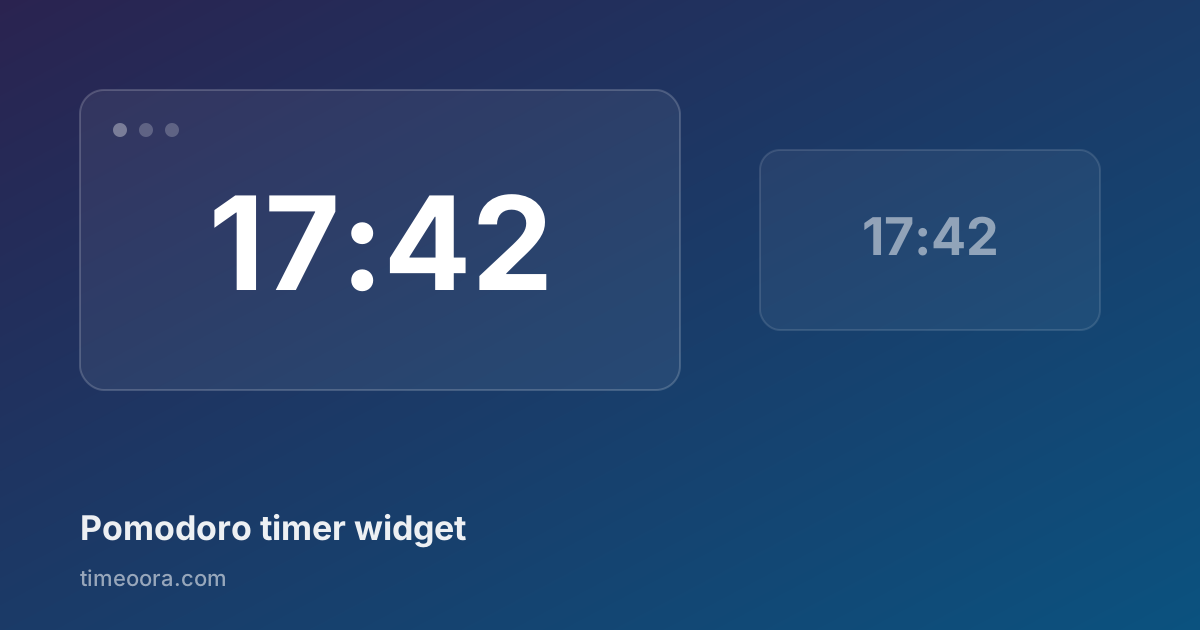
The cheapest widget you already have. A web timer that writes the remaining time into the tab title turns every tab in your browser into a status bar. You glance at the top of the window, you see 17:42, you go back to work.
Timeoora does this by default: the countdown lives in the tab title whether or not the timer page is the one you are looking at. Open the timer, start a session, then go read documentation in another tab — the number keeps ticking where you can see it.
A pinned second window
Drag the timer into its own browser window, shrink it, and park it in a corner of the screen. On most systems you can keep that window always on top. This is the closest thing to a native desktop widget, and it costs nothing to set up.
Full-screen mode is the opposite approach and works just as well for deep sessions: one window, one number, nothing else. Use the pinned window when you need to see your work at the same time, and full screen when you need to see nothing but the clock.
Your phone as a second screen
Put the timer on your phone, lean the phone against your monitor, and you have a dedicated timer display that never competes with your work for screen space. This works better than it sounds — the physical separation means the timer is outside the machine where the distractions live.
A web timer beats an app here, because there is nothing to install and nothing to sign into on the second device.
The sound
The least visual widget, and often the best one. If the bell reaches you, you do not have to look at anything at all. That is the point of the break signal: it means you can stop monitoring the clock and give the work your whole attention, because the timer will interrupt you when it is time.
Why "always visible" changes the work, not just the timing
There is a difference between knowing you are in a focus block and seeing that you are. The visible clock does something a mental note cannot: it makes the boundary of the session real. When you feel the pull to check something unrelated, the number in the corner answers before you finish the thought — eleven minutes left, it can wait.
That is also why the timer should be boring to look at. A widget that animates, blinks and demands attention has become a distraction of its own. It should be legible in a glance and forgettable in the next second.
Practical setup
Here is a setup that takes two minutes and holds up:
- Open the timer in a tab you never close. The tab title carries the countdown.
- For long sessions, put it in full screen on a second monitor, or on your phone.
- Turn the bell on. It is the part that lets you stop watching.
- Name the session. Not for the timer — for you, thirty seconds later, when you have forgotten what you sat down to do.
None of this requires an account, an install, or a subscription. A browser tab and a bell will outperform most productivity systems, because the only thing they ask of you is to start.