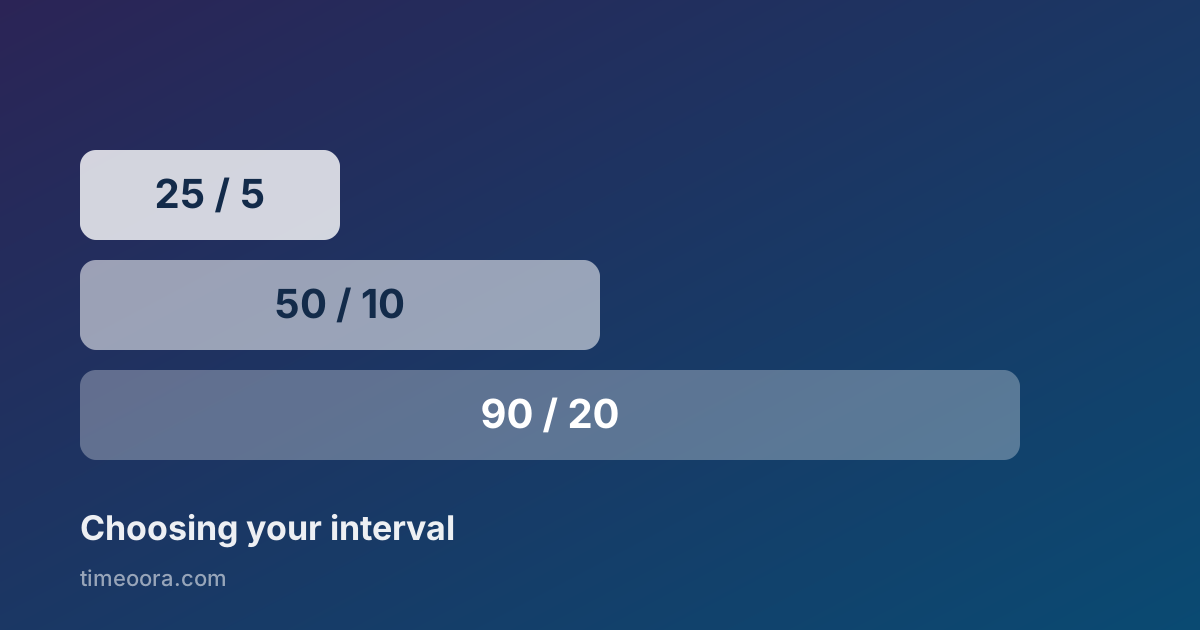
Twenty-five minutes is the most famous number in productivity, and it is arbitrary. Francesco Cirillo picked it in the late 1980s because that was the setting on the tomato-shaped kitchen timer he had. It works remarkably well, but it works well as a starting point, not as a rule you owe anything to.
The right interval is the one that matches two things: how long your work takes to get going, and how long your attention holds before it degrades.
The three intervals that cover almost everyone
25 / 5 — the default
Best for work you avoid, work that arrives in small pieces, and any day where starting is the hard part. Twenty-five minutes is short enough to feel affordable: you can talk yourself into it when you cannot talk yourself into an afternoon.
It is also the best interval for interrupt-heavy environments. If someone talks to you every twenty minutes anyway, a ninety-minute block is a fiction.
Use it when: you procrastinate on starting, your work is fragmented, or you are new to timed work.
50 / 10 — the working default for most knowledge work
Writing, coding, designing, studying anything with depth. These tasks have a warm-up cost — the first ten minutes are spent reloading context — and a 25-minute block spends nearly half of itself getting ready.
Fifty minutes gives you roughly forty minutes of real work after the warm-up, and ten minutes is long enough to actually leave the desk.
Use it when: you routinely feel the timer ring right as you were getting somewhere.
90 / 20 — for one hard thing a day
Ninety minutes is often cited as the length of the body's natural activity cycle, and while the research on ultradian rhythms is softer than most productivity writing admits, the practical observation holds: a long block is the only way certain problems get solved, and after one of them you are genuinely done for a while.
Do not schedule three of these in a day. One, in the part of the day where your attention is best, and let the rest of the day be shorter blocks.
Use it when: the work requires holding a lot of structure in your head at once.
How to tell you picked wrong
The timer rings and you resent it. Your block is too short. You were in the middle of something and the interruption cost you more than the break gave back.
You check the clock repeatedly. Your block is too long for that task, or the task is badly defined. Attention drifts toward the timer when it cannot get traction on the work.
You skip the break. This is the real warning sign, and it usually means the break is too short to be worth taking, or you are treating breaks as optional. A break you always skip is not a break; it is a lie in your schedule.
You finish the block with nothing to show. The interval is not the problem. The task was too vague to start. "Work on the report" is not a session; "write the summary section" is.
The breaks are not the leftover part
Whatever ratio you pick, protect the break. Sustained attention degrades — that is not a character flaw, it is how attention works — and the pause is what resets it. The break is doing work even though it does not look like it.
Two rules make breaks effective:
- Leave the screen. A break spent scrolling is the same input your attention just got tired of.
- Do not start something with a hook. Video, chat and news are designed not to end. That is how a five-minute break becomes forty.
Every four blocks, take a long one — fifteen to thirty minutes. This is the part people skip first and the part that makes the method sustainable past week two.
How to test a new interval properly
Change one thing and give it a week. Not a day — a week absorbs the interruptions and the bad afternoons.
Then compare two numbers: how much focused time you logged, and how many blocks you finished without abandoning. A longer interval that you abandon halfway is worse than a shorter one you complete.
In Timeoora you can set focus, short break and long break to whatever you want on the customize page, and the session history will show you which week actually produced more work. Change the numbers, run the week, read the chart. That is the whole experiment.